

UK Government's Health Bill Hands Ministers Sweeping Powers Over NHS Patient Data, Including Patient's DNA
*Your patient data will be controlled and stored by US Spy and Genocide Company PALANTIR*
*There is NO PATIENT Opt-out of your Data being used politically and commercially*
The legislation, quietly published this week, would abolish NHS England and create a mandatory national health record system built on Palantir infrastructure — with no patient opt-out
The government's Health Bill, introduced to Parliament this week, would give the Secretary of State for Health unprecedented powers to access, share, and commercialise patient medical records — including DNA sequences — with minimal legal safeguards and no right for patients to opt out.
The Bill, which began circulating as the "NHS Modernisation Bill" before being published under a different name, opens with the abolition of NHS England under Clause 1. But it is Clauses 47 to 57, covering data, that have drawn the sharpest criticism from health data experts.
 A single record for every patient — held by Palantir
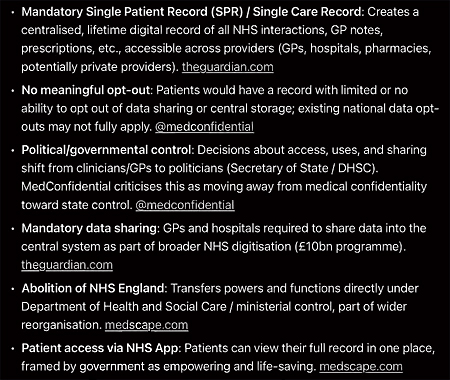
Under the Bill, every patient in England would have a Single Patient Record (SPR) consolidated within the NHS's Federated Data Platform, currently provided by the US defence contractor Palantir.
The record would bring together all medical notes, prescriptions, and genetic data. Existing GP opt-outs would be overridden, according to analysts who have reviewed the legislation.
The legal test required for a minister to access that data is low:
The Bill specifies it need only be "expedient," or that the Secretary of State "considers that disclosing the information is a proportionate means of achieving a legitimate aim."
Critics describe this as among the weakest possible legal thresholds.
What the Bill permits
A detailed clause-by-clause analysis of the legislation identifies the following provisions:
- The Secretary of State may collect and share patient data as he sees fit, with no requirement for patient consent
- Commercial access to the data is explicitly permitted, with patients having no right to object
- Read and write access to the platform extends across "the British Islands" — meaning data on English patients could be processed under Scottish or other jurisdictions' rules
- Existing duties of medical confidentiality are set aside at ministerial discretion
- Healthcare professionals who refuse to use the Single Patient Record face regulatory sanction or fines
- Doctors using the platform would be legally required to write patients' private health details back into it
- The legislation extends to children's social care data, despite that being outside the Department of Health's remit
- There is no patient opt-out written anywhere in the Bill
The Bill also strips away existing statutory data protections and merges all current NHS data flows into the new SPR framework. Notably, while the scope of NHS data collection is expanded, the remit of the National Data Guardian is not extended to cover the new powers.
Parliament criticised for fast-tracking
The Bill was published without the usual advance notification to bodies that would be legally required to comply with it, and without a programme motion debate to allow parliamentary scrutiny. Commentators have called on MPs to vote against the programme motion in order to allow more time for review.
Andy Burnham's Greater Manchester NHS — which has previously resisted the Federated Data Platform — is cited as a specific example of a system that would be overridden by the new legislation, despite having developed its own functioning data infrastructure.
Cancer care and the offshore risk
Analysts warn that once the Bill passes, cancer patients would face a binary choice: allow their DNA to be entered into the Palantir system, or forgo NHS cancer treatment. They also raise concerns about data being processed in offshore British Island jurisdictions — such as tax havens — beyond the reach of English enforcement powers, potentially allowing onward sale of patient data.
The concern is not hypothetical: UK Biobank, which shares institutional culture with NHS data bodies, previously used data collected under pandemic emergency powers for wider purposes, including making it available to researchers in China.
Background
Wes Streeting, the outgoing Health Secretary who introduced the Bill, has faced scrutiny over Palantir's links to his political mentor, Peter Mandelson. Streeting acknowledged when introducing the legislation that he would not himself be the minister wielding the powers it creates.
The Bill is currently before Parliament. Health data campaign group medConfidential, which produced the analysis on which this article is based, has said it will continue reviewing the remaining clauses — covering NHS reorganisation — in the coming weeks.
Meanwhile, take a look at NHS doctors organisations opinion of what We Streeting's legacy has been - boosted private healthcare?
Source: KeepOurNHSPublic / Mr Mark E Thomas / DrSteveTaylor / Doctors Association UK GP Comittee / MedacConfidential
